We can't find the internet
Attempting to reconnect
Something went wrong!
Hang in there while we get back on track

Experienced Boaters
Make Better Brokers.
Call us today and see for yourself.

Does Your Next Yacht Actually Fit Your Dock? What Southwest Florida Buyers Need To Know
In Southwest Florida, the “right yacht” is not just about length and layout. If you plan to keep your yacht at your Cape Coral, Fort Myers, Naples, or Marco Island home, dock and marina fit will determine whether that yacht is enjoyable to own—or a constant problem.
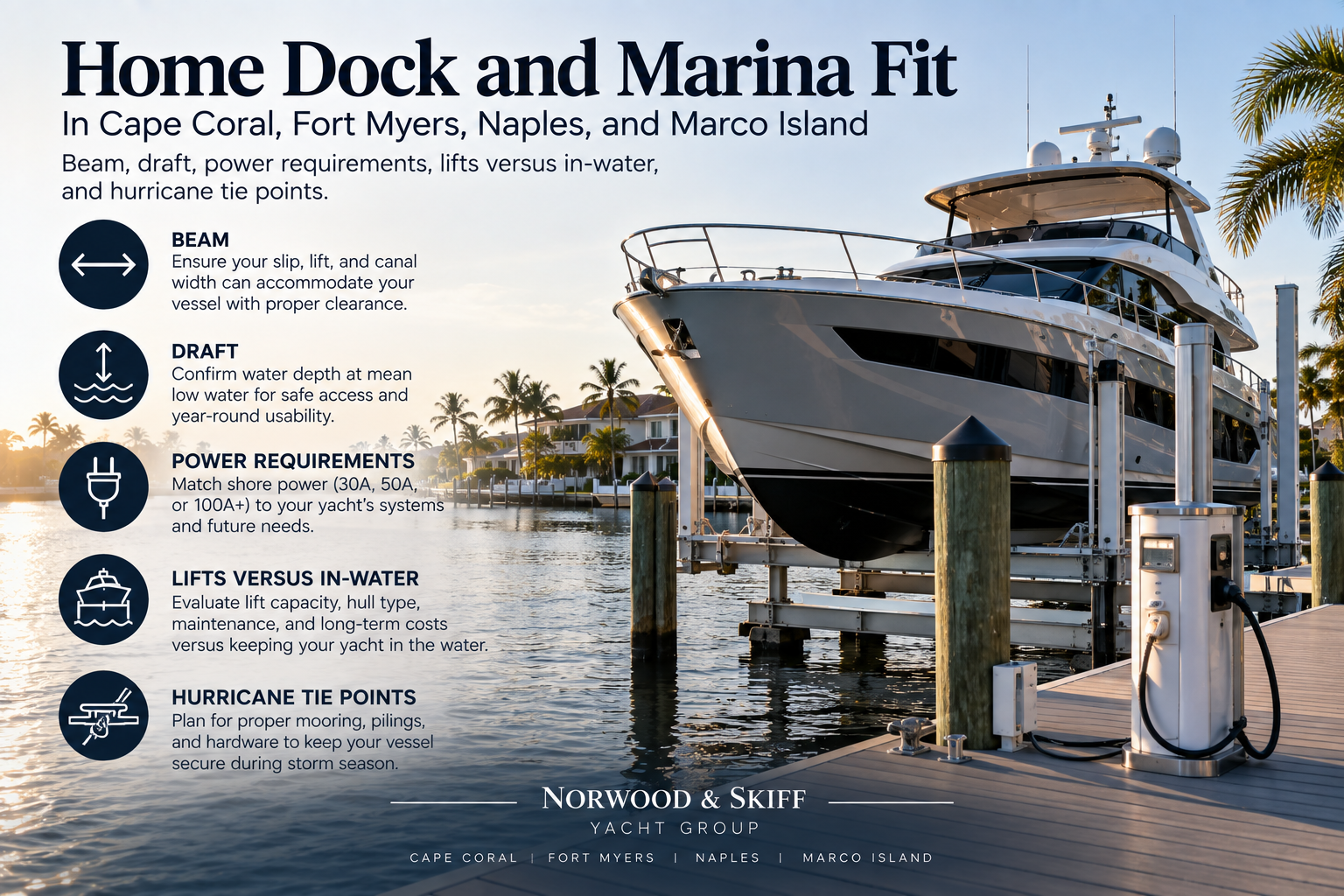
At Norwood & Skiff Yacht Group, we spend as much time talking about beam, draft, shore power, and hurricane tie points as we do about cabins and flybridges. Here’s how to evaluate your property and local marinas before you buy, so your new yacht actually fits and functions.
1. Start With How You Really Plan To Keep The Yacht
Before you look at specific models, get clear on:
- Will the yacht live at your home dock full-time?
- Do you have (or want) a lift, or will it stay in the water?
- Are you comfortable using a marina or dry storage instead of the house?
- How often will you cruise—weekends, seasons, or long-range?
Your storage and dock options will influence what type of yacht makes sense, especially in canal systems like Cape Coral, Isles of Capri, or Marco Island’s waterways.
2. Beam: Will the Yacht Physically Fit the Dock and Canal?
Beam is the yacht’s widest point. Many buyers focus on length, but in Southwest Florida:
- Dock width and piling spacing often limit beam more than length.
- Canal width and turning radius can be a bigger constraint than actual slip length.
What to measure at home
-
Clear width between pilings or between dock and opposite bank
- Leave working room for fenders and safe boarding.
- As a rule of thumb, you want at least 2–3 feet total clearance beyond the yacht’s beam.
-
Canal width and turning room
- Measure or estimate the narrowest section between your dock and open water.
- Consider whether a 45–60 ft motor yacht can realistically turn and maneuver, especially in wind and current.
-
Bridge and overhead clearance (air draft)
- Air draft is the height from the waterline to the highest point on the yacht.
- Bridge heights in Cape Coral, Fort Myers, Naples, and Marco Island can rule out certain flybridge and hardtop yachts, even if they fit at the dock.
An experienced captain-broker can look at your address on a chart and satellite view, pair it with published bridge clearances and local knowledge, and quickly rule in or out certain yacht types.
3. Draft: Can You Get In and Out Year-Round?
Draft is how deeply the yacht sits in the water. In Southwest Florida’s shallow, tide-influenced waters, draft is critical.
Why draft matters here
- Seasonal low tides can expose limitations you don’t see on a calm showing day.
- Canal depth and shoaling near channel entrances can restrict deeper yachts.
- Bahamas and Great Loop plans may influence whether you want a shallow-draft cruiser or are comfortable with more draft.
What to check
- Ask for local depth soundings at mean low tide, especially in your canal and at any choke points.
- Talk with nearby owners about the deepest boats that comfortably operate from your street or marina.
- Use draft as a functional limit, not just a published number—some boats squat more under load or at speed.
A yacht with the right draft for your property can mean the difference between confident, frequent use and waiting for “just the right tide” to get out.
4. Shore Power: Matching Your Dock To Modern Yachts
Many Southwest Florida homes were built with smaller boats in mind. A 40–60 ft motor yacht can have very different power requirements than a 25–30 ft center console.
Common yacht shore power setups
- 30A 125V (smaller cruisers, many express boats)
- 50A 125/250V (larger cruisers, motor yachts)
- Dual or even twin 50A connections (bigger yachts, more systems)
What to evaluate at your dock
- Existing shore power pedestals: amperage, voltage, receptacle type
- Electrical service capacity to the property: is there headroom to upgrade?
- Cable routing and strain relief: are connections protected from wake and tidal movement?
Retrofitting from a single 30A plug to twin 50A service is not just a plug swap—it can involve panel upgrades and professional electrical work. It often makes more sense to choose a yacht whose shore power matches what your property can realistically support, or budget for a proper dock upgrade as part of the ownership cost.
5. Lift Versus In-Water: Choosing the Right Storage Strategy
In Southwest Florida, the decision to keep a yacht on a lift or in the water affects:
- Maintenance and bottom growth
- Access and boarding
- Mechanical systems (shafts, pods, outboards, stabilizers)
- Insurance and hurricane plans
When a lift can make sense
- Smaller yachts and powerboats that are within rated lift capacity
- Outboard-powered center consoles and dual consoles
- Canal homes where bottom growth is aggressive and you want minimal diver work
If you plan a lift, confirm:
- Rated capacity versus the yacht’s real loaded weight (fuel, water, gear).
- Beam and bunk configuration relative to running gear and stabilizers.
- Access for service technicians with the boat out of water.
When in-water storage is more appropriate
- Larger motor yachts beyond safe lift size
- Vessels with pods, fins, or complex underwater gear that need correct support
- Owners who expect frequent use and easy step-aboard access
If you go in-water, plan for:
- Proper bottom paint and anode strategy
- Regular bottom cleaning by a diver
- Reliable shore power and battery charging to protect systems
6. Hurricane Tie Points and Storm Planning
Every Southwest Florida yacht owner needs a clear hurricane and severe weather plan, especially those keeping boats at home.
What to look for at your property
- Substantial pilings or anchor points suitable for cross-tying
- Room to double up lines and set spring lines to control surge and movement
- Safe access to the boat in deteriorating conditions (so you’re not adjusting lines in unsafe circumstances)
Marina considerations
If you plan to use a marina as part of your storm strategy:
- Ask about hurricane policies, haul-out options, and priority lists.
- Confirm pile height relative to expected surge.
- Understand what’s your responsibility versus the marina’s during a named storm.
An appropriate yacht choice will align with a realistic storm plan—whether that means a haul-out option, a protected hurricane hole, or robust tie points at home.
7. How Norwood & Skiff Helps You Match Yacht To Dock
The hard part of yacht brokerage begins where the listing ends. For buyers planning to keep a yacht at home in Cape Coral, Fort Myers, Naples, or Marco Island, we routinely:
- Review your property, dock, and canal using charts, satellite imagery, and on-the-water knowledge.
- Evaluate bridge clearances, canal width, and depth against specific yachts you’re considering.
- Advise on beam, draft, and air draft limits and what that means for model selection.
- Discuss shore power, lifts, and in-water storage in the context of your actual electrical service and dock structure.
- Coordinate with your surveyor and service providers to align technical findings with your docking plans.
- Recommend walking away from yachts that don’t fit your home or intended cruising pattern—even if they look attractive on paper.
The goal isn’t simply to “make a deal happen.” It’s to help you buy the right yacht for how you actually intend to use and keep it, with a clear understanding of ownership costs, dock limitations, and regional realities.
If you’re considering a yacht purchase and plan to keep it at a Southwest Florida home or marina, we’re glad to review your property and talk through what truly fits.
Contact Norwood & Skiff Yacht Group to discuss your dock, your cruising plans, and the yachts that make sense for both.