We can't find the internet
Attempting to reconnect
Something went wrong!
Hang in there while we get back on track

Experienced Boaters
Make Better Brokers.
Call us today and see for yourself.

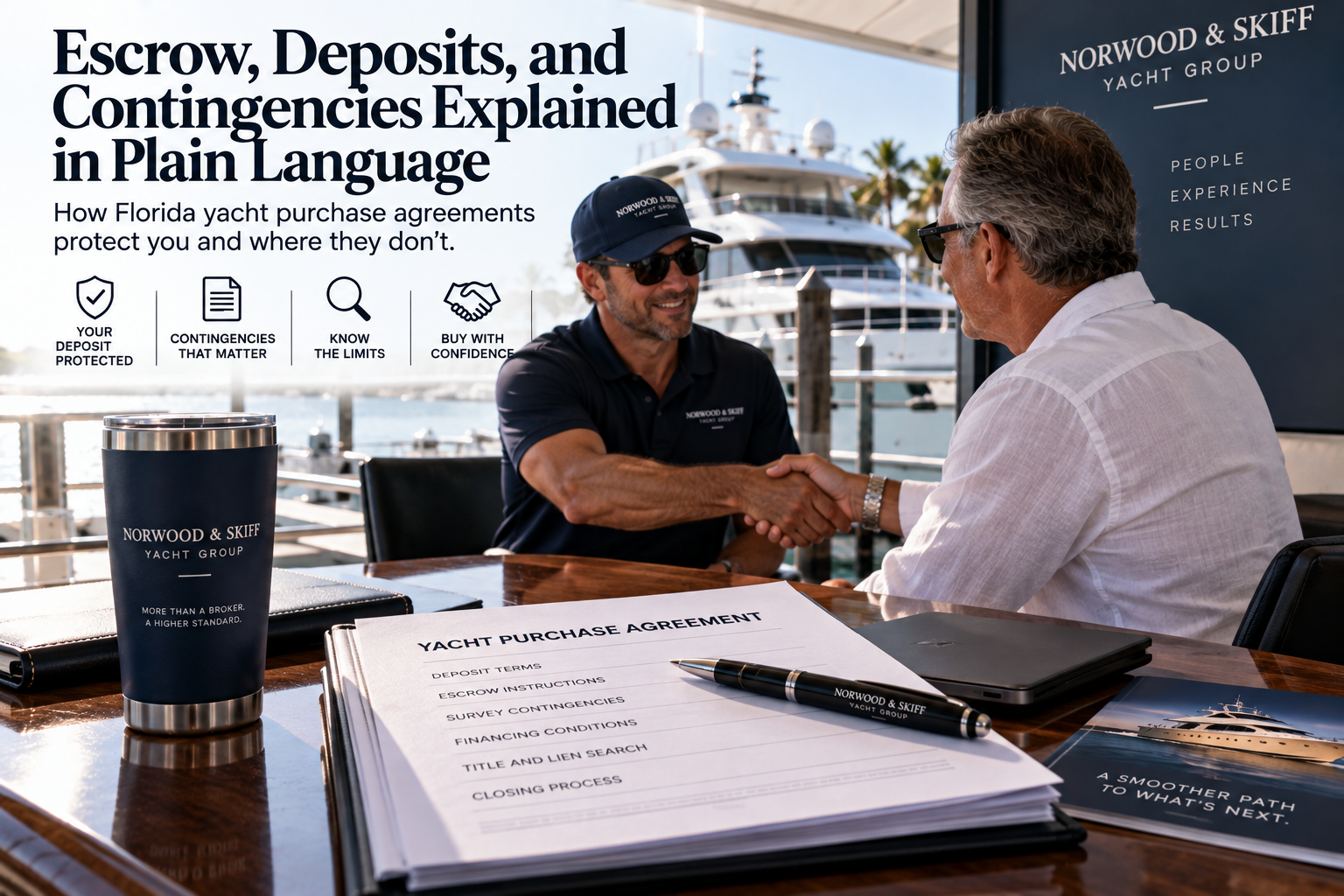
Escrow, Deposits, and Contingencies: How Florida Yacht Contracts Really Work
Most Florida yacht buyers and sellers dislike fine print—but the fine print is where your money and your risk are actually allocated.
This overview explains, in plain language, how deposits, escrow, surveys, sea trials, and contingencies typically work in a Florida yacht purchase agreement, where they protect you, and where they don’t. It’s based on how transactions actually unfold in markets like Cape Coral, Fort Myers, Naples, Marco Island, and the broader Southwest Florida coast.
The Basics: Offer, Deposit, and Escrow
Offer and Acceptance
A yacht purchase in Florida usually starts with:
- A written offer (the purchase agreement/contract)
- An agreed price and basic terms
- A good-faith deposit wired into escrow
When the seller signs your offer (or you both sign a counteroffer), you have a binding purchase agreement—subject to any contingencies.
What Is Escrow?
Escrow is a neutral account held by a third party (often a brokerage, closing service, or attorney) where:
- The buyer’s deposit is held
- Funds are released only when contract conditions are met
- In disputes, the escrow agent follows the contract and sometimes court or arbitration orders
Norwood & Skiff works with established yacht escrow providers and follows strict procedures for sending, holding, and releasing funds. You should never wire money directly to an individual seller.
The Deposit: What It Is (and Isn’t)
The deposit is usually a percentage of the purchase price that:
- Shows the seller you’re serious
- Reserves the yacht during your due diligence period
- Becomes part of the purchase price at closing
It is not automatically “non-refundable.” Whether you get it back depends on the contingencies in your contract and whether you follow the contract’s deadlines and procedures.
Common deposit expectations in Florida yacht brokerage:
- Paid promptly after contract execution (often within 1–2 business days)
- Held in a separate escrow account, not commingled with operating funds
- Refunded or forfeited based on clear, written contract language
Contingencies: Your Contract Safety Valves
A contingency is a condition that must be satisfied for the deal to move forward. If a contingency is not met and you follow the contract process, you can usually walk away and recover your deposit.
Key contingencies in a Florida yacht purchase agreement typically include:
1. Survey Contingency
A marine survey is a professional inspection of the yacht’s structure, systems, and overall condition.
The contract usually gives you:
- A set number of days to complete the survey
- The right to accept, reject, or renegotiate based on survey findings
- A process for notifying the seller in writing
If the survey reveals significant issues—structural damage, major engine problems, moisture intrusion, safety deficiencies—you may:
- Request repairs or a price reduction
- Request a credit at closing
- Reject the yacht and cancel the deal
If you reject the yacht within the agreed timeframe and under the contract’s terms, your deposit is usually refundable.
2. Sea Trial Contingency
A sea trial is the on-water test of the yacht’s performance and systems.
You’re evaluating:
- Engines, gears, and props under load
- Steering, controls, electronics, stabilizers, thrusters
- Temperatures, vibration, noise, and handling
- Practical fit for how you actually intend to use the yacht
If the yacht fails to perform as represented or has serious operational issues, you may again accept, renegotiate, or terminate under the sea trial contingency—if you do so within the contract deadlines.
3. Title and Lien Contingency
The seller must deliver clear title, free of undisclosed liens and encumbrances. This includes:
- Bank loans and mortgages
- Mechanic’s liens
- Crew claims or other recorded interests
- Documentation or registration issues
If a title search reveals problems that cannot be resolved within the contract’s timelines, the deal often terminates and the buyer’s deposit is refunded. This is one area where a competent closing agent and experienced broker are crucial.
4. Financing and Insurance Contingencies (If Applicable)
Not every deal uses these, but they are important when:
- You need financing approval from a marine lender
- Your lender has specific survey or valuation conditions
- You must secure insurance coverage to close
If financing or insurance is a requirement, it must usually be written clearly into the contract. Otherwise, failure to secure a loan or insurance may not be a valid reason to get your deposit back.
What Happens If the Deal Goes Sideways?
If the Survey or Sea Trial Fails
If you:
- Complete the survey/sea trial within the allowed time
- Provide written notice that you are rejecting the yacht under those contingencies
- Follow the specific procedure in the contract
Then your deposit is typically refundable, and the contract is terminated.
If you miss a deadline, stay silent, or fail to follow the written process, the contingency may be deemed satisfied and your deposit may be at risk if you later walk away.
If Title or Documentation Problems Arise
If the seller cannot deliver clear title or proper documentation by the agreed closing date:
- The buyer usually has the right to terminate
- The deposit is generally refunded
- Both parties walk away without further obligation (other than any specific costs addressed in the contract)
In some cases, you may agree to extend deadlines to allow the seller to resolve issues—but this should be managed in writing, not verbally.
If the Buyer Simply Changes Their Mind
If you decide not to proceed for reasons not covered by a contingency—or after contingencies have been waived or deadlines have passed—the seller may claim your deposit as liquidated damages (a pre-agreed remedy for default).
Whether the seller actually receives those funds can depend on:
- The exact contract language
- Any dispute resolution/arbitration clauses
- Whether both parties sign escrow release instructions
Escrow agents generally will not release disputed deposits without mutual agreement or legal direction.
Where Florida Yacht Contracts Protect You—and Where They Don’t
Florida brokerage contracts are designed to balance buyer and seller interests, but they have limits.
Where They Help Protect You
- Clear processes for survey, sea trial, and title review
- Defined deadlines and written notice requirements
- Escrowed deposits, rather than funds going directly to the seller
- Structured remedies if contingencies fail
Where They Do Not Fully Protect You
- They do not replace a thorough marine survey and mechanical inspection
- They do not guarantee future performance or eliminate ownership risk
- They do not protect you if you ignore deadlines or fail to follow written procedures
- They may not cover every “what if” scenario (e.g., last-minute cold feet or change in personal circumstances)
This is why experienced buyer representation matters. The contract is only as effective as the judgment guiding how you use it.
Why an Experienced Yacht Broker Matters in Southwest Florida
In Cape Coral, Fort Myers, Naples, Marco Island, Punta Gorda, and surrounding Southwest Florida waters, technical and regional knowledge affect almost every part of a contract:
- Draft and air draft relative to canals, bridges, and skinny water
- Dockage and lift suitability for the actual yacht you’re buying
- Insurance requirements, especially with hurricane exposure
- Realistic survey expectations in a harsh saltwater, high-UV environment
At Norwood & Skiff, our brokers come from the captain, management, and service side of yachting, not just sales. We help you:
- Structure deposits and contingencies that match the yacht and your risk tolerance
- Interpret survey and sea trial results in operational terms
- Decide when to renegotiate and when to walk away
- Understand what happens to your deposit under different scenarios—before you send the wire
The listing will not tell you these things. Experienced judgment will.
Talk with a Broker Before You Sign or Send a Deposit
If you’re considering buying or selling a yacht in Southwest Florida and want clear, experienced guidance on escrow, deposits, surveys, sea trials, and contingencies, Norwood & Skiff Yacht Group is available to help.
Contact our Cape Coral-based team to discuss your situation confidentially and understand your options before you commit funds or sign a yacht purchase agreement.