We can't find the internet
Attempting to reconnect
Something went wrong!
Hang in there while we get back on track

Experienced Boaters
Make Better Brokers.
Call us today and see for yourself.

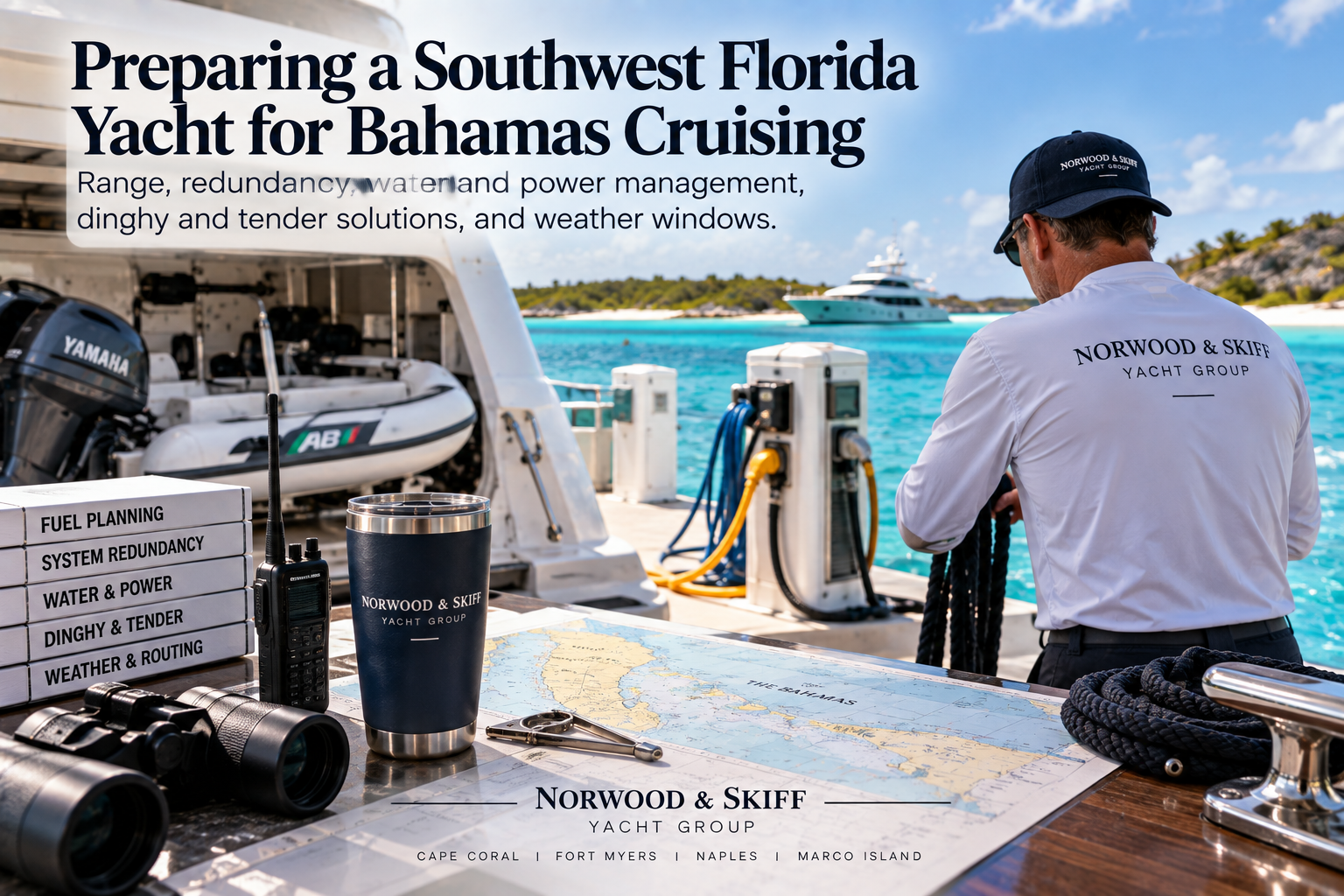
Preparing a Southwest Florida Yacht for Bahamas Cruising: What Buyers Need to Get Right
Running a Southwest Florida yacht across to the Bahamas is not a complicated ocean crossing—but it is far more demanding than a weekend run to Sanibel or Naples. For buyers evaluating yachts in Cape Coral, Fort Myers, Naples, Marco Island, Punta Gorda, and Charlotte Harbor, Bahamas readiness should influence which yacht you pursue, what you offer, and what you focus on at survey and sea trial.
This is where experienced judgment matters. A Bahamas‑capable yacht is not just about length and staterooms; it’s about range, redundancy, water and power management, tender solutions, and a realistic plan for weather windows.
Below is a practical framework Norwood & Skiff brokers use when helping clients choose and evaluate yachts for Bahamas cruising.
1. Range: Can You Make the Crossings You Actually Want?
Range is how far the yacht can travel on a reasonable fuel reserve. For Bahamas cruising from Southwest Florida, think beyond “Can I cross to Bimini?” and ask:
- What’s my safe range with a 20–25% fuel reserve?
- Can I run between islands without constantly hunting fuel?
- How does real‑world consumption compare with the brochure?
Typical considerations:
- Departure points: Many Southwest Florida owners stage via Miami, Fort Lauderdale, or the Keys before crossing to the Bahamas.
- Crossings: Miami–Bimini is roughly 50 NM; Florida Keys–Bimini or Cat Cay can be similar; longer runs to the Exumas or Abacos raise the bar.
For buyers, range should affect:
-
Model selection
- Fast express cruiser with modest tanks vs. slower trawler‑style with big tanks.
- Planing hull at 24 knots vs. same hull at 8–10 knots—dramatically different fuel burn.
-
Offer strategy
- If fuel capacity, burn rate, or tank condition is marginal for your plans, that’s an adjustment point on price—or a reason to walk away.
-
Survey focus
- Fuel tank material and age.
- Evidence of contamination (algae, water, sludge).
- Accessibility for future tank cleaning and filtration upgrades.
Red flag: A yacht that looks ideal on paper but only achieves “brochure range” at an impractical, slow speed you will never actually run.
2. Redundancy: Planning for the Off‑Day, Not the Best Day
When you’re 40–80 miles from home, redundancy stops being a luxury. It is your safety margin.
Key redundancy areas:
-
Navigation and communications
- Primary and backup chartplotters/tablets.
- AIS, VHF with DSC, and ideally a backup VHF.
- Offshore‑capable communication (satellite messenger/phone) for more remote Bahamas cruising.
-
Power and starting
- Dual batteries or battery banks separated properly.
- Emergency parallel capability to start engines or generator.
- Manual overrides where appropriate.
-
Fuel and filtration
- Dual Racor filters per engine where feasible.
- Clear bowls and pressure/vacuum gauges so you can see clogging early.
- Adequate spares for filters, belts, impellers, and common failure items.
-
Steering and control
- Inspection of steering systems (hydraulic, power‑assist, fly‑by‑wire).
- Backup/manual steering options where available.
For buyers, redundancy impacts:
-
Model choice:
- Twins vs. single engine with get‑home system.
- Complex pod‑drive systems vs. conventional shafts, based on your comfort and service access.
-
Offer and refit planning:
- If a yacht lacks redundancy but is otherwise strong, you may budget and negotiate for upgrades (filtration, electronics, battery capacity).
-
Survey items:
- Load‑testing batteries.
- Examination of fuel and electrical systems under realistic loads, ideally during sea trial.
3. Water and Power Management: Living Comfortably Away From the Dock
In the Bahamas, water and power are often the limiting factors, not the hull.
Water Management
You’re balancing:
- Tank capacity vs. how many people and how long you’ll be out.
- Watermaker (desalinator) vs. relying on marinas and jerry cans.
- Usage habits: Showers, laundry, dishwashing, and freshwater washdowns add up quickly in tropical heat.
On the buy side:
-
A reliable watermaker can transform a good Bahamas yacht into a great one—but only if:
- It’s sized appropriately.
- It’s installed correctly and has documented maintenance.
-
Survey scrutiny:
- Test the watermaker under load.
- Inspect plumbing, pumps, accumulators, and water heaters.
- Look for leaks and tank contamination.
Power Management
You need to support:
- Air conditioning in Florida and Bahamas heat.
- Refrigeration and freezers for longer provisioning.
- Navigation electronics, autopilot, entertainment systems.
- Davits or cranes for the tender.
Questions that should guide your search:
- Is the generator appropriately sized, and how many hours does it have?
- Does the yacht have sufficient battery capacity and modern charging (inverter/charger, solar where appropriate)?
- Can the electrical system handle extended anchoring without constant generator use?
During survey and sea trial:
- Run full house loads: multiple A/C units, galley appliances, electronics, and thrusters if applicable.
- Monitor voltage, temps, and noise/vibration from the generator.
- Confirm shore‑power configurations match typical Bahamas and Florida marina power.
4. Dinghy and Tender Solutions: Your Real “Car” in the Bahamas
In many Bahamas anchorages, your tender is how you get ashore, explore, fish, and dive. The wrong tender solution can make or break the trip.
Key considerations:
-
Size and capacity
- Enough load for your typical crew plus gear.
- Sufficient freeboard and power for chop and current.
-
Stowage and deployment
- Swim‑platform hydraulic lift, davit on flybridge, garage, or on‑deck chocks.
- How easy is it for your crew to launch and retrieve in a 2–3’ chop?
-
Power
- Outboard horsepower and reliability.
- Fuel sharing with the mothership where possible (gas vs. diesel considerations).
Impact on search and valuation:
- Some otherwise appealing yachts have awkward or unsafe tender systems for older owners or small crews.
- A well‑integrated, modern tender package can justify a stronger offer; a poorly thought‑out solution may require negotiation or planned refit.
Survey and inspection focus:
- Structural condition of davits, lifts, and attachment points.
- Hydraulic and electrical operation under load.
- Tender hull and engine condition, including age, hours, and service history.
5. Weather Windows: Matching Yacht Capability to Real Conditions
The Gulf Stream and Bahamas Banks demand respect. A weather window is a forecast period when conditions are favorable for your route and vessel.
What this means for yacht selection:
-
Hull type and ride
- Deeper‑V planing hull vs. flatter hull vs. stabilized motoryacht.
- Seakeeper or fin stabilizers: helpful for comfort, but not a substitute for sound weather judgment.
-
Speed vs. comfort
- Faster boats can shorten exposure to marginal conditions but may ride harsher at speed.
- Slower, heavier yachts may ride better but require more precise timing.
For buyers, weather readiness should drive:
-
Intended use clarity:
- Are you crossing only on near‑perfect days, or do you need a yacht that handles a broader range of conditions?
-
Survey items:
- Condition of stabilizers, trim tabs, and running gear.
- Structural integrity: stringers, bulkheads, tabbing, and any evidence of hard impacts.
- Helm ergonomics and visibility for long runs.
How These Factors Should Shape Your Purchase Process
When Norwood & Skiff represents Bahamas‑minded buyers, we structure the process around:
-
Use‑case definition
- How often will you go to the Bahamas?
- How many people, how long, how far between marinas?
- Are you focused on Exumas, Abacos, Berry Islands, or primarily Bimini/Cat Cay?
-
Model screening
- Eliminate yachts that can’t meet realistic range, water, power, or tender requirements for your plan.
- Focus on hull forms, systems, and layouts that fit Southwest Florida home‑port realities (draft, air draft, canal width, dockage).
-
Offer strategy
- Align price with market evidence, but adjust for systems condition, redundancy, and likely Bahamas upgrades.
- Build Bahamas‑specific items into the offer and survey plan (watermaker testing, generator load testing, tender systems, fuel range validation).
-
Survey and sea trial focus
- Run the yacht the way you intend to use it: offshore runs, generator under load, anchoring systems, tender operations.
- Use survey findings to refine your understanding of ownership costs and whether the yacht truly fits your Bahamas plans.
Sometimes the conclusion is that the yacht is a strong candidate at the right price. Sometimes the conclusion is that you should walk away and keep looking. Both are successful outcomes if they prevent an expensive mistake.
Talk With a Broker Who Has Run the Miles
If you’re in Cape Coral, Fort Myers, Naples, Marco Island, Punta Gorda, or the surrounding Southwest Florida markets and you’re thinking about a Bahamas‑capable yacht, it pays to work with brokers who care about how the yacht will actually perform once you leave the pass.
Norwood & Skiff’s captain‑brokers combine operating experience, technical judgment, and transaction expertise to help you choose, evaluate, and negotiate the right yacht for your Bahamas cruising plans.
Contact Norwood & Skiff Yacht Group to discuss your routes, your home dock, and the yachts you’re considering—and get candid guidance before you buy.