We can't find the internet
Attempting to reconnect
Something went wrong!
Hang in there while we get back on track

Experienced Boaters
Make Better Brokers.
Call us today and see for yourself.

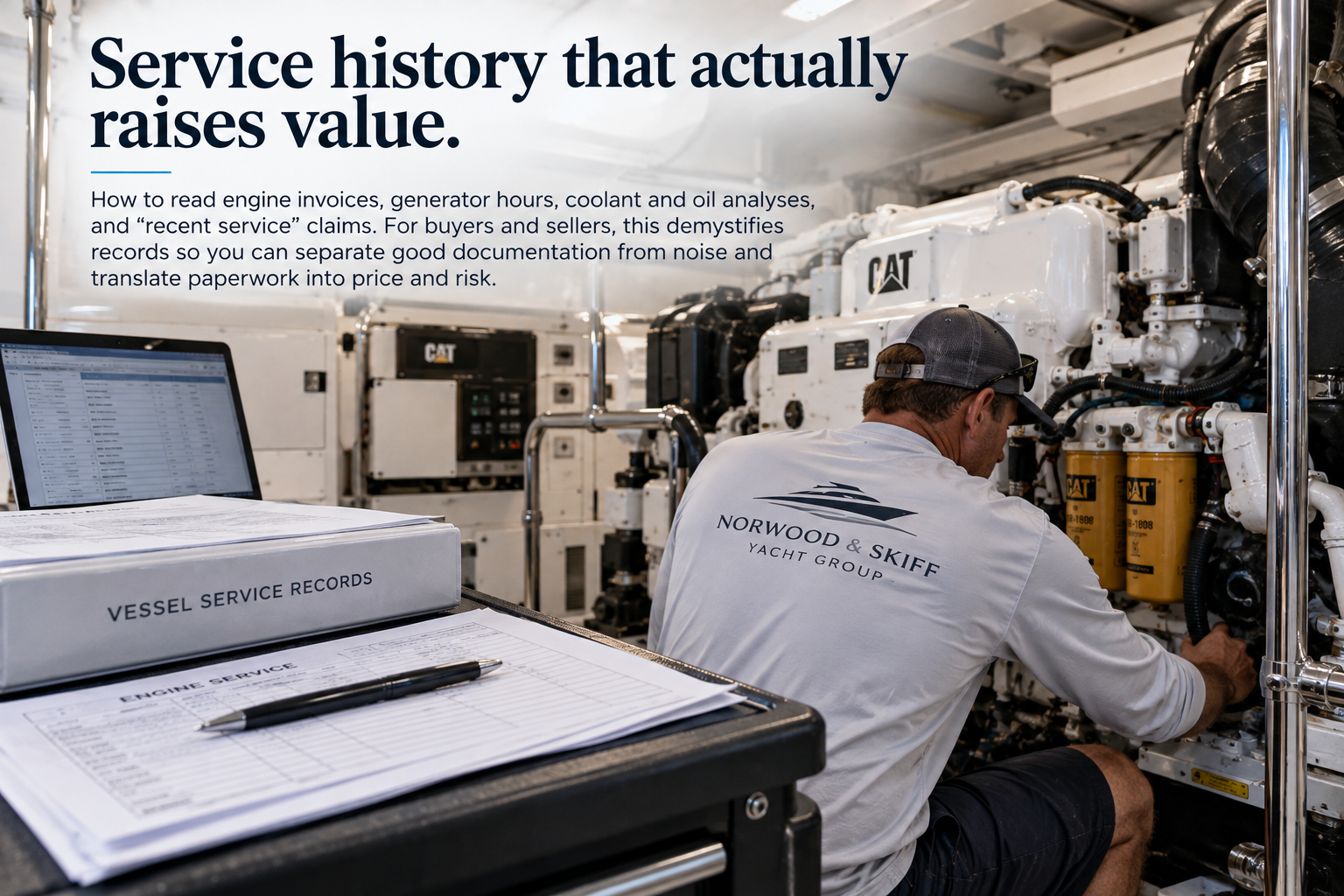
Service History That Actually Raises Value: How To Read Yacht Maintenance Records
On paper, almost every yacht has “recent service” and “meticulously maintained” in the description. In reality, service history ranges from genuinely value‑adding maintenance to vague claims that don’t survive basic scrutiny.
Understanding the difference is one of the most important parts of yacht due diligence. Done correctly, it can change what you offer, what you accept, and whether you should walk away.
At Norwood & Skiff Yacht Group, we read engine invoices and service records every day. Below is how we think about documentation that genuinely raises value—and how buyers and sellers in Southwest Florida can translate paperwork into price and risk.
Why Service History Matters More Than Shiny Gelcoat
A clean hull and fresh wax sell photos. They do not tell you how the yacht has actually been operated or what it will cost to own.
Good service history helps you:
- Confirm that required engine and generator services are up to date
- Understand how hard the yacht has been run and in what conditions
- Anticipate upcoming expenses (cooling system overhauls, aftercoolers, pods, stabilizers)
- Support a higher asking price—or justify a lower offer
- Reduce the risk of expensive surprises after closing
On the flip side, poor or missing documentation is not always a deal‑breaker, but it does increase risk. That should be reflected in negotiation and contingencies.
“Recent Service” Claims: What They Should Actually Mean
Listings love the phrase “recent service.” It is meaningless without detail.
When you see “recent service,” you should ask:
- What was done? (specifically)
- When was it done? (date and engine hours)
- Who did the work? (reputable yard, dealer, or unknown mobile tech?)
- Is there an itemized invoice? (parts and labor)
Red flags:
- “Serviced” with no invoice or only a credit-card slip
- Only oil changes listed as “full service” on high‑hour engines
- Big-ticket items mentioned verbally but not documented
- Missing engine hours on invoices—no way to tie work to current hours
A serious seller with a good yacht will not mind providing organized documentation. As a buyer or buyer’s broker, you are not being difficult by asking; you are doing responsible due diligence.
How To Read Engine Invoices Like a Broker
An engine invoice is more than a receipt—it is a snapshot of how the mechanical side of the yacht has been treated.
Key elements to look for:
-
Engine serial numbers
- Confirm the work applies to the actual engines on board.
- Useful when verifying with manufacturers or dealers.
-
Engine hours at time of service
- Let you map service intervals against manufacturer recommendations.
- Help you see patterns of use (light seasonal use vs heavy charter‑style hours).
-
Itemized work descriptions
Look for more than “perform service.” Value‑adding detail includes:- Valve adjustments, injector service, aftercooler and heat exchanger cleaning
- Replacement of raw‑water pumps, belts, hoses, and thermostats
- Gearbox service: oil changes, filter changes, pressure checks
- Software updates on electronic engines
-
OEM parts and fluids
- Invoices specifying manufacturer‑recommended fluids and filters show the owner followed guidance.
- Generic or vague parts descriptions are not automatically bad, but they warrant questions.
-
Patterns over time
- Consistent annual or hour‑based services = good discipline.
- Long gaps or “catch‑up” services immediately before listing = possible deferred maintenance.
For sellers, clean, complete engine invoices support a higher, defensible asking price. For buyers, they give you evidence to either proceed confidently or negotiate based on upcoming needs.
Generator Hours: What They Really Tell You
Generators are often worked harder than main engines, especially on air‑conditioning‑dependent boats in Florida.
When evaluating a generator:
-
Compare hours to vessel age and usage pattern
- A Southwest Florida cruiser used year‑round should have meaningful generator hours; “amazingly low hours” can also mean long periods sitting unused—also not ideal.
-
Check service intervals
- Oil and filter changes (often every 100–200 hours)
- Impeller, heat exchanger, and exhaust elbow inspection/replacement
- Mounts, wiring, and control board checks
Good generator records can be a quiet but significant value driver, especially on yachts where quiet, reliable AC and house power are essential to your boating plans.
Coolant and Oil Analysis: Lab Reports That Matter
Fluid analysis (coolant and oil) is one of the most objective tools you have during due diligence.
What they can indicate:
- Wear metals (iron, copper, aluminum, chromium): potential internal wear
- Contaminants (fuel, coolant, water): leaks or internal failures
- Additive package health: whether the oil is breaking down prematurely
How to use them:
- Treat single samples cautiously; trends are more useful than one report
- Compare samples taken at different hours from the same engine
- Pair lab results with mechanical inspection and sea trial data
For buyers, fresh analysis done as part of a survey can confirm what the records suggest—or raise questions that need answers. For sellers, providing past labs plus fresh reports shows confidence in the machinery.
Maintenance Records: Organized vs. Noise
Good documentation is not about paper volume; it is about clarity.
High‑quality records usually include:
- Log of major services with date and engine hours
- Invoices from recognized yards or technicians
- Documentation for engines, gearboxes, generators, pods, stabilizers, thrusters, and major electrical work
- Records of cooling system services (heat exchangers, aftercoolers, intercoolers)
- Documentation of any significant failures and corrective work
“Noise” looks like:
- Stacks of fuel and marina receipts presented as “full history”
- One‑off minor fixes with no indication of broader maintenance
- Random loose pages with no way to connect work to the current state of the yacht
In negotiation, organized records can legitimately justify a higher price and faster sale. Disorganized or sparse records should shift the discussion to risk, not just cosmetics.
Translating Paperwork Into Price and Risk
Here is how we think about service history when advising clients:
-
Strong, complete history
- Supports the higher end of realistic market value
- Justifies a more competitive offer
- Reduces the need for large “unknown” reserves in your budget
-
Partial or inconsistent history
- Neutral to slightly negative for value
- Justifies price adjustments for known upcoming services
- Requires careful survey, sea trial, and possibly contingency renegotiation
-
Minimal or no records
- Not an automatic “no,” but it is a higher‑risk proposition
- Offer should reflect the possibility of catching up on years of deferred maintenance
Risk‑adjusted value—not just asking price—should drive your decisions.
How Norwood & Skiff Helps You Read Between the Lines
Because our brokers come from captain, service, and technical backgrounds, we do more than collect PDFs:
- We tie invoices to specific engines, generators, pods, and systems
- We compare service intervals to manufacturer recommendations
- We identify missing “big ticket” services that are coming due
- We coordinate with surveyors, labs, and technicians during due diligence
- When appropriate, we advise clients not just how to negotiate, but when to walk away
Whether you are buying or selling in Cape Coral, Fort Myers, Naples, Marco Island, Sanibel, Captiva, Pine Island, Punta Gorda, or Charlotte Harbor, you are operating in a salt, heat, and hurricane environment where maintenance history is not optional—it is central to value.
If you want an experienced yacht broker to help you interpret service records, survey findings, and ownership costs—not just open doors—contact Norwood & Skiff Yacht Group to speak directly with a broker in Southwest Florida.