We can't find the internet
Attempting to reconnect
Something went wrong!
Hang in there while we get back on track

Experienced Boaters
Make Better Brokers.
Call us today and see for yourself.

How Captain‑Broker Expertise Elevates Your Yacht Search
When you’re considering a six‑ or seven‑figure yacht, “nice photos and a good feeling” aren’t enough. The best buyers and sellers want decisions backed by real seagoing expertise: how the boat docks, rides, and performs when everything is on the line.
That’s where a captain‑broker changes the entire experience.
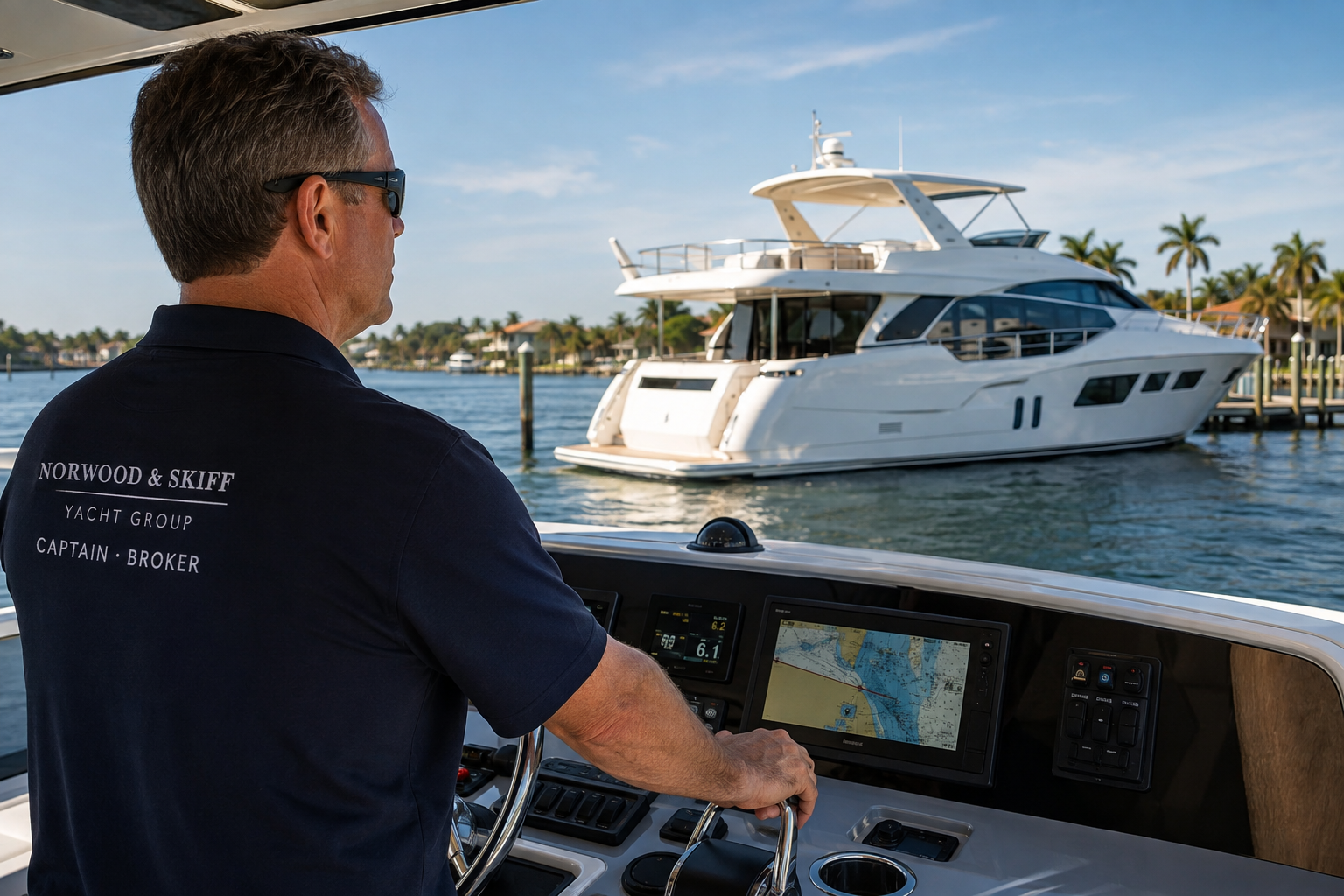
At Norwood and Skiff Yacht Group in Cape Coral, Florida, our brokers are seasoned captains who have run, maintained, and evaluated yachts for decades. Clients often credit captain‑broker Lee Scheele’s methodical approach—docking tests, seakeeping evaluations, and full systems checks—as the standard that gives them the confidence to move forward (or walk away) with clarity.
Below is how that expertise elevates your yacht search and protects your investment.
Why a Captain‑Broker Is Different From a Standard Yacht Broker
A traditional broker understands the market. A captain‑broker understands the vessel AND the market behind it.
That difference shows up in three critical ways:
- Hands‑on operational knowledge – A captain knows how a hull should feel at the helm, how systems should behave under load, and how a yacht should respond in tight quarters.
- Real‑world risk assessment – Years of command experience translate into a sharp eye for what can go wrong offshore, not just at the dock.
- Offer strategy grounded in performance – Instead of negotiating only from photos, specs, and comps, a captain‑broker negotiates from how the yacht actually performs in the real world.
This is the core of the Norwood and Skiff Yacht Group approach: your offer is informed by genuine seafaring insight, not guesswork.
Docking Tests: Where Handling Meets Reality
Many yacht decisions are made based on appearance and layout. But experienced owners know: if a yacht is stressful to dock, it won’t get used as often—and its true cost will feel a lot higher.
A professional captain‑broker doesn’t just step aboard and admire the finish. They insist on:
Real Dock‑Handling Scenarios
Under Lee Scheele’s standard, a proper docking test will typically include:
- Backing into a slip in realistic marina conditions
- Side‑to docking against pilings or a fuel dock
- Tight‑quarters maneuvering around other vessels and obstacles
- Use (and limits) of bow/stern thrusters and joystick systems
What your captain‑broker is assessing:
- Does the yacht respond predictably at idle and just above idle?
- Is the visibility from the helm adequate when docking?
- Are controls smooth, intuitive, and responsive?
- Does the boat carry momentum in a way that suits your skill level?
This is where our captain‑brokers can look you in the eye and say, “You will be comfortable handling this boat,” or, “This may demand more crew or practice than you want.” That clarity is invaluable.
Seakeeping Evaluations: How the Yacht Behaves Offshore
A sea trial is not a sightseeing cruise. Done correctly, it’s a structured test of seakeeping—a yacht’s behavior and safety characteristics underway in realistic conditions.
Experienced captains like Lee Scheele evaluate:
Hull Performance and Ride Quality
- Acceleration and planing – Does the boat climb on plane promptly, without excessive bow rise?
- Trim and attitude – Is the running angle comfortable and efficient at cruise?
- Response to trim tabs/joysticks – Do small adjustments meaningfully improve ride and fuel burn?
- Handling in turns – Any tendency to skid, lean excessively, or feel uncertain?
Comfort in Real‑World Seas
Whenever conditions allow, captain‑brokers will observe:
- Up‑sea, down‑sea, and beam‑sea behavior – Does the yacht pound, roll, or track poorly?
- Spray and dryness – Are decks and windows staying reasonably dry, or constantly awash?
- Noise and vibration – Are there concerning harmonics, rattles, or vibrations at certain RPMs?
Engine and Propulsion Performance
Your captain‑broker will work closely with surveyors but also brings their own operational eye:
- WOT (wide‑open throttle) numbers – Does the yacht achieve rated RPM and expected speed?
- Cruise‑speed efficiency – Are fuel burn and speed in line with manufacturer data and comparable models?
- Smooth shifting and engagement – Any hesitation, clunking, or lag in the drivetrain?
The result is a seakeeping profile, not just a “yes/no” answer. That profile directly informs whether the yacht aligns with how—and where—you plan to use it.
Systems Checks: Beyond the Survey Report
A marine survey is essential, but a captain‑broker goes further by interpreting how systems will impact your day‑to‑day ownership.
During onboard inspections and trials, our captain‑brokers focus on:
Critical Operational Systems
- Engines and generators – Start behavior, warm‑up characteristics, load handling, and shutdown procedures.
- Electrical systems – Battery banks, charging, load management, and real‑world use of house power at anchor.
- Hydraulic and steering systems – Responsiveness, redundancy, and any signs of leaks or lag.
Comfort and Livability Systems
- Air conditioning and refrigeration – Can the system realistically keep the yacht comfortable in Florida summers?
- Water systems – Freshwater pumps, water heaters, watermakers, and tank capacities.
- Electronics and navigation – Integration of plotters, radar, AIS, autopilot, and cameras for the way you actually run the boat.
A captain‑broker like Lee Scheele will translate findings into plain language:
- What is “nice to have” versus “must address before closing”
- What might become a reliability issue on a Bahamas or East Coast run
- What to budget for in the first 12–24 months of ownership
This turns a long survey report into clear, prioritized guidance you can act on.
How This Expertise Shapes a Smarter Offer
All of this—docking tests, seakeeping evaluations, and systems checks—feeds into a sharper negotiation strategy.
With Norwood and Skiff Yacht Group representing you, your offer is:
- Aligned with true condition – You’re not overpaying for hidden deficiencies or underappreciated strengths.
- Structured with meaningful contingencies – Sea trial, survey, and specific system performance benchmarks protect your deposit.
- Backed by data and experience – When our captain‑brokers push for price adjustments or repairs, it’s supported by real performance findings, not vague concerns.
For sellers, this same expertise lets us pre‑empt surprises, address issues before listing, and present your yacht with credibility to serious buyers—often shortening time on market and protecting your net proceeds.
Buyers and Sellers: Schedule a Consultation for Best Representation
Whether you’re buying your first yacht or trading up to a larger vessel along the East Coast of Florida, a captain‑broker’s expertise can be the difference between a good transaction and a great one.
Norwood and Skiff Yacht Group brings over 1,000 successful yacht deals, seasoned captains as brokers, and a standard of due diligence many clients now insist on as non‑negotiable.
If you’re ready for representation that includes real docking tests, seakeeping evaluations, and systems checks—not just paperwork—contact Norwood and Skiff Yacht Group today to schedule a consultation. Let’s make your next yacht decision confident, informed, and truly world‑class.