We can't find the internet
Attempting to reconnect
Something went wrong!
Hang in there while we get back on track

Experienced Boaters
Make Better Brokers.
Call us today and see for yourself.

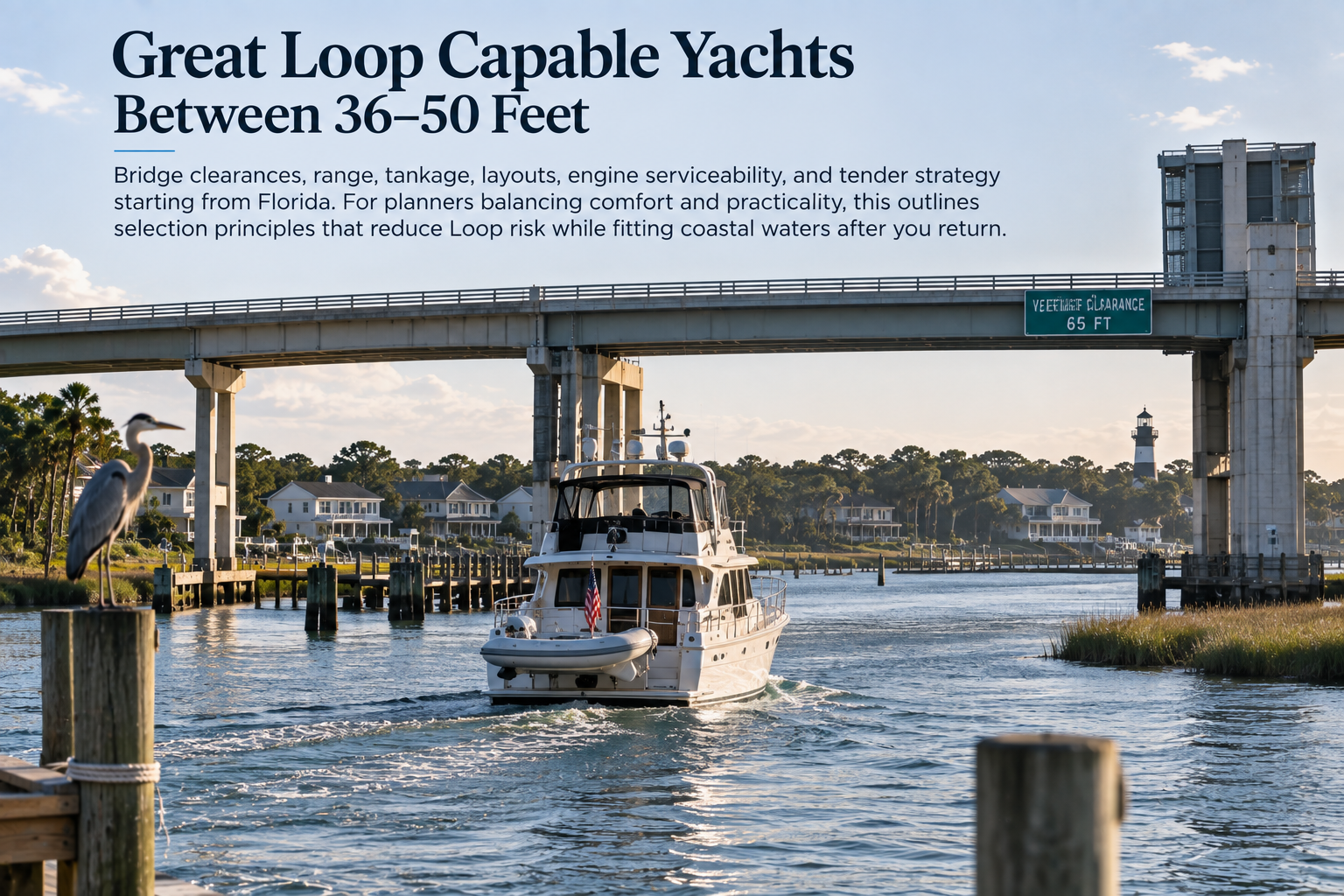
Great Loop Capable Yachts 36–50 Feet: Practical Selection for Southwest Florida Owners
Planning the Great Loop from a Southwest Florida home base is different from planning it from the Great Lakes or the Chesapeake. Your yacht has to clear Chicago’s railroad bridges, carry the fuel and water you need for long stretches, handle the ICW, rivers, and open sounds—and then still make sense back home in Cape Coral, Fort Myers, Naples, Marco Island, Punta Gorda, and Charlotte Harbor.
For most owners, the practical “sweet spot” is a Great Loop capable yacht between 36–50 feet. Below is a framework Norwood & Skiff brokers use when advising clients on Loop-capable yachts that also work in Southwest Florida.
1. Bridge Clearance: The Non‑Negotiable Great Loop Number
On the Great Loop, the controlling fixed bridge is generally accepted as 19’ 1” near Chicago. If your air draft (height from waterline to the highest fixed point) is over that number, you’re not doing the traditional route.
Target air draft
- Ideal: 15’–17’ with radar arch and antennas lowered
- Upper practical limit: Under 19’ with mast/arch down and everything that can fold removed
What that means in real boat terms
- Flybridge motor yachts: Often workable only if the arch/mast folds and the bridge enclosure can be lowered or removed. Full hardtops can be a problem.
- Sedan/express cruisers: Frequently easier to get under 17–18 feet with a hinged mast or arch.
- Trawlers and downeast boats: Many popular “Loop” boats were designed with low air draft in mind, but add-ons (sat domes, radar, solar) can quietly push you over the limit.
Southwest Florida angle
Back home, air draft matters for:
- Cape Coral and Fort Myers canals: Fixed bridges, utility lines, and tight turning basins
- Naples, Marco Island, Punta Gorda: Access to slips with bridge or power-line restrictions
- Ongoing use: A yacht that barely squeezes under 19’ for the Loop but struggles under local bridges can be frustrating long-term.
A Norwood & Skiff broker will look beyond the brochure number and evaluate real-world air draft with your planned electronics, dinghy, and hardware installed.
2. Range and Tankage: Rivers, Sounds, and Fuel Planning
On most of the Loop, fuel is reasonably available, but you want margin. You’re dealing with current, weather delays, and the occasional closed fuel dock.
Fuel capacity and range
For a 36–50 foot Loop-capable yacht:
- Diesel is strongly preferred for safety, longevity, and availability.
- Minimum practical range: 250–300 nautical miles at your planned cruise speed with a conservative reserve.
- Comfortable range target: 350–400+ nautical miles with reserve, especially if you prefer to run faster occasionally.
Range is not just about tank size. It’s:
- Tankage (gallons)
- Fuel burn at realistic RPM
- Hull type (planing vs semi-displacement vs displacement)
- How you actually intend to run the boat
Fresh water and waste
Many first-time Loopers underestimate:
-
Fresh water capacity:
- 100–150 gallons is workable for a couple who are disciplined.
- 150–200+ is more comfortable, especially with guests.
-
Waste holding:
- Larger holding tanks reduce “pump-out anxiety” in remote areas.
Southwest Florida angle
- In Cape Coral, Fort Myers, Naples, and Marco, you’ll appreciate efficient fuel burn for day trips and Bahamas runs, not just the Loop.
- A yacht that can comfortably run from Southwest Florida to the Keys or the Bahamas without stressful fuel stops often fits Loop range requirements as well.
3. Layout and Liveability: Comfort Without Losing Practicality
You can spend 6–12 months on the Great Loop. Layout matters as much as brand.
Cabin and salon considerations
-
Two real sleeping cabins are highly desirable for a couple:
- One owner’s cabin (fore or midship)
- One guest/office cabin that can double as storage
- Separate shower stall: A proper stand-up shower reduces daily frustration.
-
Galley usability: You will cook aboard. Prioritize:
- Usable counter space
- Refrigeration and freezer capacity
- Ventilation
Deck and helm
- Side deck access: Safe side decks with handholds are important for locking through and docking.
- Helm visibility: Good sightlines when docking in tight canals or dealing with lock turbulence.
-
Weather options:
- Enclosed flybridge or pilothouse for colder portions of the Loop
- Adequate shading and ventilation for Florida heat
Southwest Florida angle
When you return:
- Open, shaded cockpit areas are valuable for fishing, sandbar days, and entertaining.
- Air conditioning capacity and insulation matter for Florida summers and dockside living.
- A layout that works for two people long-term but can handle occasional family visits is often ideal.
4. Engine Choice and Serviceability: You Have to Fix What You Can’t Avoid
A Loop-capable yacht is not just about horsepower. It’s about access, reliability, and service support.
Engines and propulsion
- Twin diesels are common in the 36–50 foot range; single diesel with bow and stern thrusters is also viable on some hulls.
-
Serviceability: Can you:
- Access filters, belts, impellers, cooling systems without being contortionists?
- Reach shaft seals, strainers, batteries, and steering gear?
Service network
-
On the Loop, you want engines and systems that:
- Have wide parts availability
- Are familiar to regional mechanics
-
After the Loop, in Cape Coral, Fort Myers, Naples, Marco Island, you want:
- Engines that local yards and mobile mechanics routinely support
- Realistic maintenance and overhaul costs for your budget
Pods, stabilizers, and systems
- Pods (Zeus, IPS, etc.): Great handling, but more sensitive to maintenance and grounding. Groundings are common in shallow Florida and parts of the Loop.
- Stabilizers (fins, gyros): Excellent for comfort in open water and Gulf crossings, but add complexity and cost.
An experienced captain-broker will help you weigh handling benefits against long-term service and failure risk, both on the Loop and back in Southwest Florida’s shallow, sometimes skinny waterways.
5. Tender Strategy: Rigid Plans for a Flexible Trip
Your dinghy is your “car” for much of the Great Loop. Getting the tender strategy wrong can make everyday life harder than it needs to be.
Key decisions
- Do you truly need a rigid inflatable with outboard, or will a smaller, lighter tender do?
-
Where will it live?
- Swim platform davits
- Hydraulic platform
- Flybridge or hardtop (more weight and height)
- Tow-behind (more complexity)
Trade-offs
-
A big RIB with a 25–40 hp outboard:
- Great for Bahamas and Keys runs and Southwest Florida beaches
- Adds weight, complexity, windage, and often air draft
-
A lighter tender with a smaller outboard or even an inflatable:
- Easier to manage for locking and seasonal storage
- Lower impact on bridge clearance
Southwest Florida angle
If Southwest Florida and the Bahamas are your primary post-Loop plans:
- It may be worth slightly more complexity (davits or a hydraulic lift) for a more capable tender—but you must still keep overall air draft under control for the Loop.
6. Southwest Florida Suitability After the Loop
A Great Loop yacht that’s miserable in Cape Coral canals or Naples marinas is not a good outcome.
Draft and maneuverability
-
Shallow draft helps in:
- Cape Coral and Fort Myers canals
- Pine Island, Matlacha Pass, Charlotte Harbor shallows
-
Bow and stern thrusters, or pods, make sense for:
- Tight docks
- Crosswinds in narrow canals
- Locking and fuel docks during the Loop
Dockage and systems
-
Make sure your planned yacht:
- Fits your home slip or a reasonably priced marina
- Has appropriate shore power (30A vs 50A) for your region
- Manages heat, humidity, and hurricane preparation realistically
How Norwood & Skiff Helps You Choose the Right Great Loop Yacht
The right Great Loop capable yacht between 36–50 feet is not just a checklist of features. It’s:
- A hull and layout that fit how you actually intend to use the boat
- Air draft, draft, range, and systems that reduce Loop execution risk
- A yacht that feels at home in Southwest Florida waters when the Loop is over
Norwood & Skiff brokers come from the captain, management, and service side of yachting. We look at:
- Bridge clearance and draft with real-world equipment, not just brochure numbers
- Range, tankage, and fuel burn against your actual plan
- Mechanical access, service history, and comparable sales
- Ownership costs, insurance considerations, and Southwest Florida dockage realities
If you’re planning the Great Loop from Cape Coral, Fort Myers, Naples, Marco Island, Punta Gorda, or nearby, and want a candid, technical discussion about which 36–50 foot yachts make sense for both the Loop and your home waters, contact Norwood & Skiff Yacht Group to speak directly with an experienced captain-broker.