We can't find the internet
Attempting to reconnect
Something went wrong!
Hang in there while we get back on track

Experienced Boaters
Make Better Brokers.
Call us today and see for yourself.

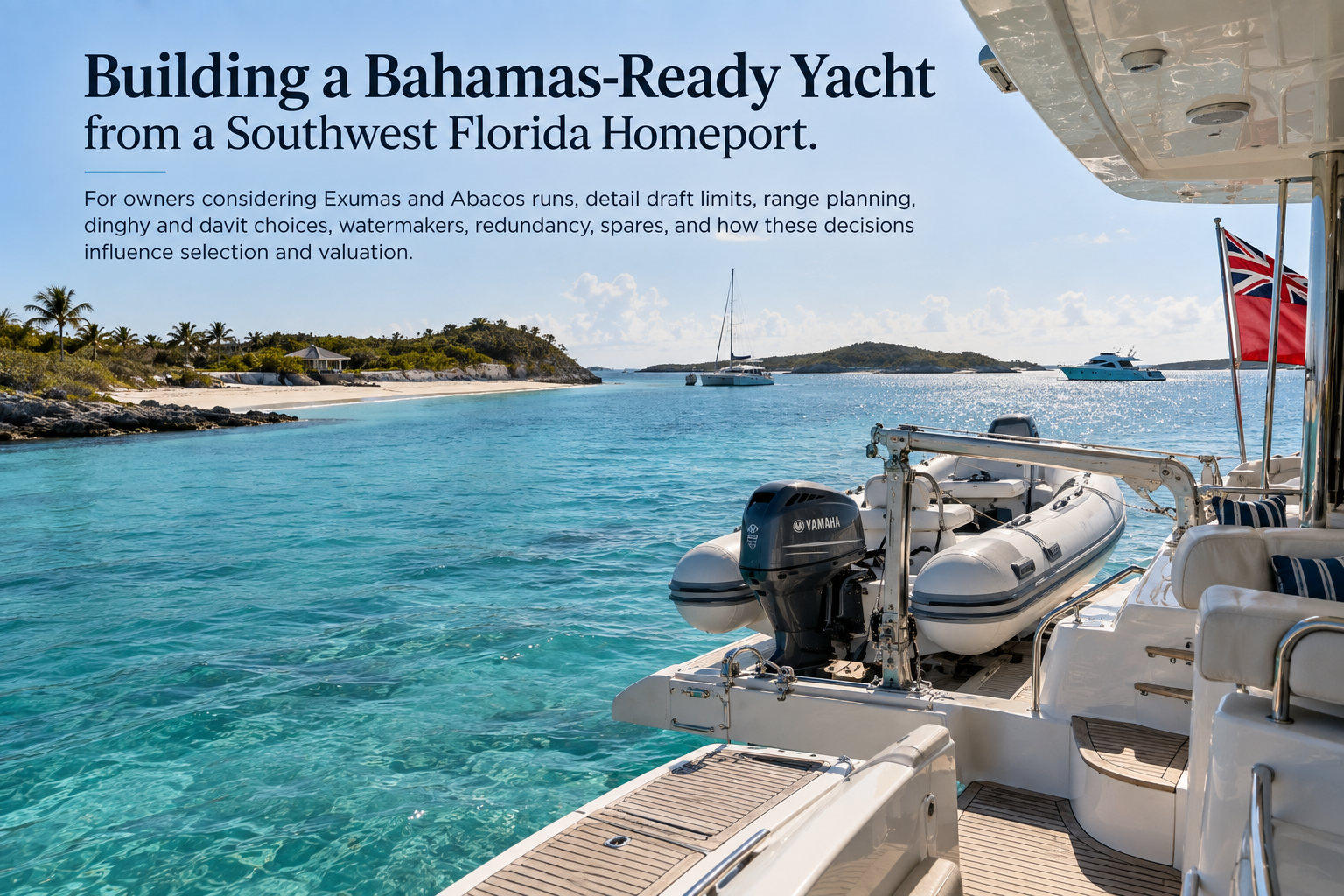
Building a Bahamas‑Ready Yacht From a Southwest Florida Homeport
Running to the Exumas or Abacos from Cape Coral, Fort Myers, Naples, or Marco Island is a very different mission than day boating in Charlotte Harbor. The same yacht that feels ideal in a Southwest Florida canal may be poorly suited to Bahamas cruising once you factor in draft, range, dinghy use, and how self‑sufficient you want to be at anchor.
For many owners, the real question is not “Can this yacht get to the Bahamas?” but “Is this the right Bahamas yacht for how we will actually use it—and what does that mean for value and resale?”
At Norwood & Skiff Yacht Group, we treat Bahamas planning as an engineering and ownership question, not a marketing slogan. Below are the core design and equipment choices we walk through with Southwest Florida owners.
1. Draft, Air Draft, and Bahamas vs. Southwest Florida Realities
Draft is how deep the hull, running gear, and appendages sit in the water. In the Exumas and Abacos, draft drives where you can anchor, how close you can get to a beach, and how tight your margins are when the tide runs out.
Practical draft considerations
For Bahamas cruising:
-
Under ~4’0” (true loaded draft):
- Access to more anchorages and cuts
- Easier in the Exumas’ shallower banks
-
Around 4’–5’6”:
- Typical for many cruising motor yachts and express yachts
- Manageable with careful route and tide planning
-
Over ~6’:
- Higher stress in the shallower cays
- More reliance on specific routes, waypoints, and tides
From a Southwest Florida homeport (Cape Coral, Fort Myers, Naples, Punta Gorda, Marco Island), you also need to clear:
- Canal depths and controlling depths leaving your dock
- Tidal lows at inlets and passes
- Prop and pod exposure in thin water
A yacht that routinely scrapes bottom in a Cape Coral canal will feel like a liability in the Exumas. That matters to market value: Bahamas‑capable shallow draft is increasingly a selling point in our region.
Air draft and bridge clearance
If you’re Great Loop‑curious or you move between Southwest Florida, the East Coast, and the Bahamas:
- Fold‑down arches, hinged masts, and careful antenna placement can add resale flexibility.
- Fixed structures that push air draft too high limit routes and shrink your buyer pool.
2. Range Planning: Not Just “How Far on a Tank”
Range is more than advertised fuel capacity. Actual Bahamas range depends on:
- True cruise speed and fuel burn (gallons per hour at a realistic cruise, not brochure WOT numbers)
- Reserve for weather detours, running the generator, and unplanned side trips
- Load: full water, provisions, tenders, and toys can materially change consumption
Southwest Florida to Bahamas legs
Common legs from our coast might include:
- Marco / Naples to Key West or Marathon
- Key West / Marathon to Bimini, Chub Cay, or Andros
- Nassau to Exumas, Exumas to Long Island, or up to the Abacos
We typically encourage owners to model:
- Comfortable no‑stress range (with 20–30% fuel reserve)
- “Two‑hop” flexibility (e.g., can you choose better weather windows rather than being forced to push on?)
From a valuation standpoint, a yacht with:
- Documented fuel burn curves
- Recent engine service
- Clean bottom and running gear
…is much more convincing as a Bahamas‑ready platform than a similar boat with unknown performance and no operating data.
3. Dinghy, Davit, and Tenders: Your “Car” in the Bahamas
In the Exumas or Abacos, the tender isn’t optional—it’s how you get to shore, run errands, explore shallows, and reach snorkeling and fishing spots.
Choosing the right Bahamas tender
Key decisions:
-
Rigid‑inflatable (RIB) vs. hard dinghy
- RIBs are the norm: stable, forgiving, and easier on yacht finishes.
-
Outboard size and fuel
- Enough horsepower to plane with your typical load but not so heavy that launching is unsafe.
- Consider sharing fuel type with the main yacht (e.g., all gasoline or a clear diesel/gas plan).
-
Length and beam
- Needs to be large enough for people and gear but still manageable in your intended davit system and storage locations.
Davit and storage options
-
Swim platform davit / hydraulic lift
- Simple for day‑use, but consider stern exposure in rough anchorages and marinas.
-
Boat deck crane and chocks
- Better protection under way but adds height and weight aloft.
-
Garage or under‑platform storage (for some express and sport yachts)
- Clean rigging and easier launch in calm conditions; check clearances and sea state limits.
For valuation, a properly matched tender/davit with clean install, appropriate capacity, and documented service is a plus. Oversized, awkward, or corroded systems become negotiation points and safety concerns.
4. Watermakers, Power, and Onboard Independence
Being able to anchor comfortably for days without chasing marinas is a major part of Bahamas cruising.
Watermakers (desalination systems)
A watermaker turns seawater into fresh water. For Bahamas runs:
-
Advantages:
- Longer time at anchor, especially in the Exumas
- Smaller marina fuel/water stops
-
Consider:
- Realistic output (gallons per hour) vs. crew usage
- Power draw (generator reliance, AC vs. DC)
- Space, noise, and service access
- Brand support in Florida and the Bahamas
A high‑quality, professionally installed watermaker with service records is an asset at resale. A neglected or DIY system of unknown performance is not.
Power and electrical planning
Think through:
- Generator capacity and hours (and whether one or two gensets make sense)
- Inverter/charger setup for quiet time without running the generator 24/7
- Air conditioning loads in Florida and Bahamas heat
- Redundant battery banks for critical systems
Buyers increasingly value yachts with sensible power management and quiet‑ship capability. That shows up in market value and days on market.
5. Redundancy and Spares: Reducing “Trip‑Ending” Failures
In the Bahamas, a simple small‑part failure can end a trip—or at least reroute it through an expensive, time‑consuming detour.
We encourage owners to think in two categories:
Critical system redundancy
- Dual fuel filters and spare elements
- Backup freshwater pump
- Redundant bilge pumps in key compartments
- Extra VHF and handheld communications
- Independent GPS and basic paper charts for your core routes
Thoughtful spares and consumables
- Impellers, belts, filters (engine and generator)
- Key fuses and relays
- Common fasteners, hose clamps, and marine sealants
- Extra dinghy prop and repair kit
- Basic plumbing parts (hoses, fittings, valves)
From a buyer’s perspective, a yacht that comes with a logical spares inventory, labeled, and documented suggests a prior owner who understood cruising. That supports risk‑adjusted value, especially for Bahamas‑oriented buyers.
6. How These Choices Influence Yacht Selection and Valuation
All of these factors—draft, range, tender system, watermaker, redundancy—feed directly into:
- Which yacht you should buy for Bahamas and Southwest Florida use
- How that yacht should be priced versus comparable sales
- What upgrades actually add value and which are strictly personal preference
A few principles we emphasize with Norwood & Skiff clients:
- Buy for actual use, not brochure range. If 80% of your boating is in Cape Coral canals, Sanibel, Captiva, and Boca Grande with one Bahamas trip every year or two, you may not need the same fuel and equipment profile as a live‑aboard Exumas cruiser.
- Condition and records often beat model year. A slightly older yacht with clean bottom, recent engines and generator service, upgraded tender, and properly maintained watermaker can be a better Bahamas buy than a newer boat with deferred maintenance.
- Lowest asking price rarely equals best value. Boats that are thin on equipment, marginal on range, or too deep for your dock may be cheaper up front and more expensive in real use and resale.
- Market evidence matters. We look at what similar Bahamas‑oriented yachts have actually sold for, with and without equipment like watermakers and modern tenders, not just asking prices.
7. Why Work With a Captain‑Broker for Bahamas Planning
Sophisticated businesspeople are not automatically sophisticated yacht buyers. Building a Bahamas‑ready yacht is part technical evaluation, part ownership planning, and part transaction management.
An experienced buyer’s yacht broker or seller’s representative should:
- Understand Southwest Florida canals, inlets, controlling depths, and dockage realities
- Evaluate draft, range, systems, and equipment against your real Bahamas plans
- Review service records and survey findings with a technical eye
- Help you weigh upgrades versus buying a different yacht
- Tell you when to walk away from a yacht that doesn’t fit your intended use or risk tolerance
Norwood & Skiff’s team comes from the working side of yachting—captains, yacht managers, and service professionals who have lived with the consequences of these decisions. Our role is to match you with the right yacht and configuration for how and where you actually boat, not to push every transaction across the finish line.
If you’re considering a Bahamas‑capable yacht from a Southwest Florida homeport, or wondering what your current yacht is really worth to that market, talk with a Norwood & Skiff broker. We’ll walk through your routes, draft limits, range needs, and equipment plan so you can make a clear, evidence‑based decision.